
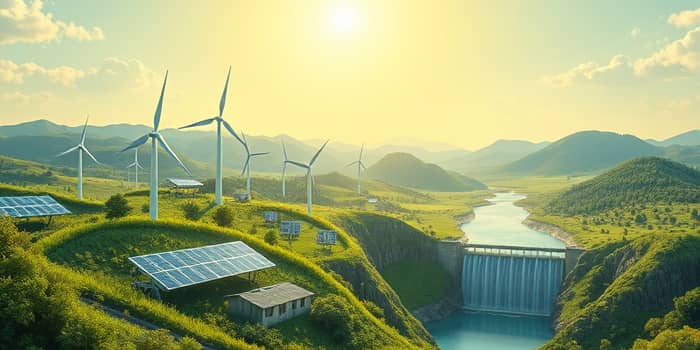
In 2026, the global energy landscape transformed as renewable sources became the backbone of electricity generation. Supported by a web of national incentives, international financing, and community-driven programs, renewables now account for 36% of global power supply. These policies have unlocked unprecedented growth, inspiring communities and industries to pivot away from fossil fuels. By harnessing wind, solar, and hydro, nations are forging resilient, sustainable grids that prioritize environmental stewardship and economic vitality.
Global Trends and Milestones
The past year witnessed the dominance of wind, solar, and hydro as the installed renewable capacity soared to 3,610 GW. Wind energy led with 1,081 GW, hydroelectricity provided 1,289 GW, and solar installations reached 754 GW, marking a pivotal shift in energy priorities. Notably, Asia-Pacific commanded 46% of this capacity, exemplifying the region’s ambitious clean power commitments.
For the first time ever, renewables surpassed coal to become the world’s primary power source, overtaking coal as the world’s top electricity provider and delivering more than 6,000 TWh of clean generation. This surge met over 90% of global electricity demand growth, setting a new benchmark for sustainable development.
Investment and Financial Momentum
Behind this clean energy revolution lies a tide of capital investments. In 2025, global energy spending exceeded $3.3 trillion, with $2.2 trillion funneled into renewables, electric vehicles, grid modernization, and storage solutions. This surge underscores a record $2.3 trillion investment in clean technologies, fostering innovation from next-generation solar cells to advanced battery systems.
- China led investments with $800 billion, equating to 4.1% of its GDP.
- Wind and solar financing faced an 18% dip in early 2025 but rebounded through safe-harbor projects.
- Private and public partnerships accelerated grid resilience projects across Europe and North America.
These financial trends illustrate how fiscal incentives, tax credits, and competitive auctions can steer vast resources toward low-carbon alternatives, ensuring both profitability and environmental impact.
Regional Highlights and Success Stories
Across continents, countries are leveraging tailored incentives to achieve remarkable milestones. From massive solar auctions to community-led wind cooperatives, each region showcases unique strategies that spur clean power adoption.
- China: Surpassed 570 GW of wind capacity, added 240 GW of solar in early 2025, and continues domestic manufacturing incentives.
- United States: With 37% of additions driven by Renewable Portfolio Standards, the US added record onshore wind and utility solar capacity.
- Europe & UK: Achieved a 63% renewable mix, reformed grids under Clean Power 2030, and enacted Future Homes Standards cutting emissions by up to 80%.
- India: Launched the Dhirubhai Energy Complex, boosting solar panel, battery, and electrolyzer production to meet growing demand.
- Latin America: Maintained hydroelectric dominance with over 25,000 plants, integrating pumped storage to optimize water resources.
Each of these success stories demonstrates how localized incentives—whether through auctions, feed-in tariffs, or manufacturing rebates—can unlock transformative growth.
Policy Frameworks Driving Change
Effective policy instruments are the backbone of renewable acceleration. By aligning regulations with market incentives, governments can guide private capital toward sustainable outcomes. The following frameworks have proven particularly impactful:
- Renewable Portfolio Standards (RPS) and feed-in tariffs that guarantee long-term power purchase agreements.
- Competitive auctions and pricing reforms that reduce procurement costs and improve transparency.
- Tax credits and accelerated depreciation for clean energy equipment investments.
These policies ensure a stable investment environment, mitigate market risks, and foster innovation across technology supply chains.
Emerging Technologies and Future Outlook
The renewable energy sector continues to evolve rapidly. Forecasts project a 2.6-fold growth in global renewable capacity by 2030, doubling renewable capacity by 2030 at a pace far outstripping previous decades. Solar PV is expected to constitute 80% of new capacity additions, while offshore wind could surge by 140 GW over the next five years.
Energy storage solutions are also scaling up, with pumped hydro set to double to 16.5 GW and battery installations becoming increasingly cost-competitive. Integrating these storage assets will be key to smoothing supply variability and ensuring grid reliability.
Beyond traditional renewables, innovations in green hydrogen, geothermal, and next-generation bioenergy are emerging as complementary pathways to decarbonize hard-to-electrify sectors, further amplifying the unprecedented global momentum for renewables.
Empowering Communities and Individuals
While national policies and corporate investments garner headlines, the power of local action cannot be overstated. Community solar programs, rooftop incentives, and microgrid grants empower households and small businesses to participate directly in the clean energy transition.
By installing rooftop solar panels or joining a cooperative wind farm, individuals can reduce energy bills, generate revenue through net metering, and contribute to a cleaner planet. Collective action at the grassroots level also builds social cohesion, fosters energy literacy, and lays the foundation for future innovations.
Conclusion: Seizing the Green Opportunity
The convergence of ambitious incentives, robust financing, and cutting-edge technologies has propelled renewable energy into its golden era. Nations that align policy frameworks with market dynamics are reaping not only environmental benefits but also economic growth, job creation, and energy security.
As we look to the future, it is imperative that governments, businesses, and citizens collaborate to sustain this momentum. By advocating for supportive policies, investing in innovation, and adopting clean energy solutions, each of us can play a crucial role in powering a greener, more resilient world.
Now is the time to harness this unprecedented momentum, to champion incentives that accelerate the clean energy revolution, and to ensure that every community—regardless of geography or income—shares in the promise of a sustainable future.
References
- https://www.abiresearch.com/blog/renewable-energy-statistics
- https://www.carbonbrief.org/iea-renewables-will-be-worlds-top-power-source-by-2026/
- https://earth.org/energy-transition-where-are-we-headed-in-2026/
- https://www.deloitte.com/us/en/insights/industry/renewable-energy/renewable-energy-industry-outlook.html
- https://www.weforum.org/stories/2025/12/global-energy-2026-growth-resilience-and-competition/
- https://www.geogreenpower.com/blog/popular-renewable-energy-sources-2026/
- https://bcse.org/market-trends/top-six-trends/