
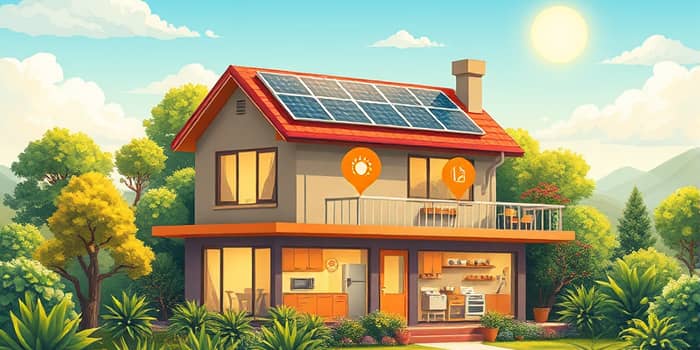
Understanding how your household consumes energy is the first step to cutting costs and reducing carbon emissions. In the United States, the average annual consumption per household stands at approximately 10500 kWh, or roughly 886 kWh per month. Historical data reveals that while total usage has remained steady, per household use has declined over decades thanks to advances in technology and efficiency standards.
Understanding Household Energy Consumption
Energy use varies significantly by region, home size, and climate. Southern states often top the charts due to increased cooling needs, with Louisiana households averaging 1149 kWh per month and monthly bills around 144 dollars. In contrast, California and Hawaii see lower usage at 536 kWh and 506 kWh respectively but face higher rates up to 42 cents per kWh. This state-by-state variation in usage underscores how climate and local costs shape consumption patterns.
Home type also influences totals. A small two-bedroom apartment may consume 600 to 900 kWh monthly, while large single-family homes can use 1400 to 2200 kWh before adding electric vehicles or pool pumps. Despite growing average home sizes from 1740 to 1818 square feet since 1980, overall consumption per household has decreased by 31 percent, illustrating the power of efficient design, building codes, and modern equipment.
Historical trends show that total U.S. residential electricity demand rose by 43 percent since 1980, yet per-household use fell by nearly a third. This anomaly highlights the role of advanced insulation, efficient appliances, and smarter controls in offsetting increased electronics ownership and larger living spaces.
Environmental and Financial Impacts
Reducing energy demand not only lowers utility bills but also cuts greenhouse gas emissions. UK retrofit programs alone are projected to save up to 0.0969 million tonnes of CO2 and 471 GWh annually by 2025. In financial terms, efficiency measures can trim residential energy spending, which now accounts for around 1.62 percent of household expenditures, up from 1.60 percent in 2023.
With prices rising to 17 cents per kWh in 2025 and 17.6 cents in 2026, even a five percent reduction in usage translates into substantial savings. For an average household consuming 10500 kWh, a 5 percent cut saves over 500 kWh, or nearly 90 dollars per year. Over a decade, that adds up to almost 900 dollars just from minor adjustments.
Energy insecurity is a growing concern. As much as 33 percent of U.S. households faced difficulty meeting energy bills in 2024, often sacrificing food or medicine. Vulnerable groups, including Native American and Black households, experience rates nearly double the national average. By adopting efficiency programs, more than half of consumers can mitigate these hardships and improve quality of life.
Major Energy Users and Efficiency Opportunities
Certain appliances dominate consumption. Air conditioning leads at 17 percent of total usage, followed by space heating at 15 percent and water heating at 14 percent. Electronics, lighting, refrigeration, and dryers contribute the rest, with miscellaneous equipment—EV charging, pool pumps, fans—accounting for about 22 percent.
Smart thermostats, heat pump installations, and LED lighting represent key retrofit options. Replacing incandescent bulbs with LEDs can offer 75-80% energy saving potential in lighting costs alone. Upgrading an older HVAC system to a high-efficiency heat pump can reduce heating and cooling expenses by up to 20 percent, especially when paired with proper sealing and insulation.
Insulating attics and walls, sealing ductwork leaks, and installing energy recovery ventilators can further enhance performance. In multifamily buildings, HVAC systems often account for 70 percent of site energy, making them prime targets for electrification and advanced controls.
Government Schemes and Incentives
Across the UK, the ECO scheme has delivered 4.9 million measures across 2.9 million homes since 2013, focusing on dwellings with lower Energy Performance Certificate ratings. In 2025 alone, it supported 271,700 upgrades, lifting many properties from EPC band D or below to band C or above.
In the U.S., federal tax credits now cover up to 30 percent of costs for heat pumps, insulation, and renewable energy systems, while state-level programs like PACE financing and utility rebates further reduce upfront expenses. These incentives, when combined, can cover a majority of home upgrade budgets and accelerate adoption of energy-saving technologies.
Public programs often fund deep retrofits that achieve substantial carbon reductions nationwide. For instance, UK schemes project annual savings of nearly half a terawatt-hour, illustrating the power of coordinated policy efforts in driving large-scale change.
Trends and Future Outlook
Electric vehicles, data centers, and the proliferation of smart devices are driving U.S. electricity demand upward. Total consumption is forecast to grow by two percent in 2025 and another one percent in 2026, adding 163 billion kWh over two years. As prices climb, efficient technologies become not only beneficial but essential for cost management.
Advances in smart home platforms, real-time monitoring, and integrated energy management are making it easier for homeowners to track usage and automate savings. Solar PV paired with home storage is gaining traction, offering a path to energy independence and peak shaving during high-rate periods.
Emerging materials, such as aerogel insulation and phase-change window coatings, promise additional gains in building efficiency. As consumer adoption of efficiency programs surpasses 50 percent in many regions, a cultural shift towards sustainable living is taking hold.
Practical Tips for Maximizing Efficiency
- Seal gaps and improve insulation: Air leaks can account for up to 30 percent of heating and cooling losses.
- Install programmable or smart thermostats: Automated schedules can reduce wasted run-time and align with occupancy patterns.
- Switch to LED lighting: Enjoy longer lifespans, cooler operation, and lower wattage consumption.
- Service HVAC systems annually: Clean filters, tune equipment, and optimize refrigerant levels.
- Upgrade to ENERGY STAR appliances: Higher efficiency ratings can cut energy use by 10 to 50 percent compared to older models.
- Consider rooftop solar and battery storage: Offset grid demand and protect against rate spikes.
By targeting these practical steps, households can start saving immediately and build on successes with larger projects over time. Each upgrade increases resilience against rising energy costs and contributes to a healthier planet.
Achieving meaningful energy efficiency is a journey that combines behavior changes, smart investments, and policy support. Armed with the latest data, incentives, and readily available technologies, homeowners can confidently reduce their footprint, secure financial savings, and lead the charge towards a sustainable future.
References
- https://www.electricchoice.com/blog/electricity-on-average-do-homes/
- https://www.eia.gov/consumption/residential/reports.php
- https://solartechonline.com/blog/average-household-power-consumption-guide-2025/
- https://www.gov.uk/government/statistics/household-energy-efficiency-statistics-headline-release-march-2026
- https://www.datainsightsmarket.com/news/article/us-power-consumption-to-hit-record-highs-in-2025-2026-16476
- https://verdant.copeland.com/blog/10-energy-efficiency-trends-multifamily-buildings-2026
- https://www.publicpower.org/periodical/article/eia-forecasts-electric-consumption-us-continue-grow-2025-2026
- https://www.nclc.org/new-data-shows-alarming-rise-in-home-energy-insecurity/
- https://www.eia.gov/pressroom/releases/press582.php
- https://www.cepro.com/news/american-homes-declare-energy-independence-in-2026/624292/
- https://bcse.org/market-trends/top-six-trends/
- https://www.eia.gov/electricity/monthly/update/print-version.php
- https://theacsi.org/news-and-resources/blog/2026/03/19/energy-efficiency-in-a-high-demand-era-why-it-matters-now/