
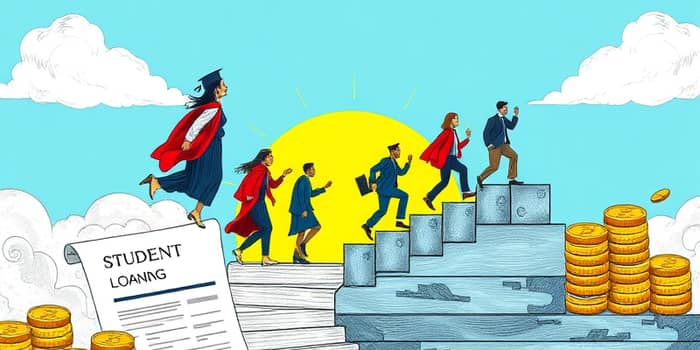
Conquering student debt demands a thoughtful approach that balances affordability, speed, and cost savings. With federal and private options evolving, borrowers need clear guidance to chart a path toward freedom.
In this comprehensive guide, we break down federal repayment plans, acceleration techniques, forgiveness programs, and 2026 regulatory shifts to help you take control of your loans.
Understanding Federal Repayment Plans
Most federal borrowers begin on the Standard Repayment Plan, featuring fixed payments over ten years. This straightforward option minimizes total interest and delivers debt freedom within 120 installments.
For those seeking lower monthly obligations, income-driven repayment (IDR) plans offer extended timelines and eventual forgiveness. As plans evolve, the Repayment Assistance Plan (RAP) will replace current IDR options for new loans issued after July 1, 2026.
To compare scenarios, use official loan simulator tools available at StudentAid.gov. Personalized estimates reveal how payment choices affect total interest and forgiveness prospects.
Acceleration Strategies for Faster Debt Freedom
Cutting years off your timeline not only reduces stress but also trims thousands in interest expense. A proactive plan leverages multiple tactics.
- Extra principal payments on loans: Always designate overpayments toward principal. Target the highest-interest balance first to amplify savings and shave years off repayment.
- Autopay discounts: Enroll in automatic debit to secure a 0.25% rate reduction on federal and many private loans, saving hundreds over time.
- Biweekly payment schedule: Splitting monthly installments into half-payments every two weeks yields one extra full payment annually without stretching your budget.
- In-school and grace period interest payments: Cover accrued interest before capitalization to prevent balance growth when repayment begins.
- Refinancing private loans: Qualified borrowers can refinance high-rate loans into shorter terms at lower rates. Assess the trade-offs, as federal benefits may be forfeited.
Combining these methods—interest payments before repayment, autopay, biweekly schedules, extra principal, and strategic refinancing—often produces the fastest path to debt freedom for eligible borrowers.
Maximizing Loan Forgiveness and Cancellation
Federal forgiveness programs have disbursed over $183 billion to date. Public Service Loan Forgiveness (PSLF) remains the fastest route, requiring 120 qualifying payments under an IDR plan while employed full-time by a government or nonprofit employer.
- PSLF: 120 on-time IDR payments plus public service employment unlock full loan balance cancellation.
- Judicial & Health Service Programs: Specific attorney and healthcare roles offer repayment rewards up to $60,000 or $75,000.
- IDR Forgiveness: Remaining balance forgiven after 20–25 years of income-based payments, varying by plan type.
Consolidation may be required to qualify certain loans for forgiveness, particularly Perkins and FFEL balances. Always verify employer and plan eligibility through the Electronic Certification Form (ECF).
Be mindful: tax treatment of forgiven debt changes in 2026. Amounts discharged after 2025 are generally taxable unless legislative extensions occur.
Preparing for 2026 Regulatory Changes
Significant shifts begin July 1, 2026. New loans will only offer the Standard Plan or RAP, and current IDR programs will sunset for loans disbursed thereafter. Adjust strategies for existing and future debt accordingly.
Key updates include:
- Graduated borrowing caps for graduate students ($20,500/year; $100,000 lifetime).
- Shortened forbearance periods (maximum 9 months per request, 2 years total).
- Taxable treatment of most forgiven balances from 2026 onward.
As rules tighten around employer eligibility for PSLF and payment-count windows shift, requires Direct Loans for eligibility becomes more critical. Borrowers should consider consolidation before mid-2026 deadlines.
Crafting Your Personalized Repayment Plan
No single strategy suits every borrower. Start by listing all loan balances, interest rates, and servicer details. Then:
1. Identify your primary goal: speed versus monthly affordability.
2. Choose a repayment plan aligned with income and career path.
3. Layer acceleration techniques—extra payments, autopay, biweekly—wherever possible.
4. Explore forgiveness programs if you qualify for public service, healthcare, or legal roles.
5. Revisit your plan annually or when income changes. Tools at StudentAid.gov empower you to model adjustments and stay on track.
By combining informed plan selection, strategic overpayments, and timely consolidation or refinancing, you can navigate the evolving landscape with confidence and discover a clear path to student debt freedom.
References
- https://www.nerdwallet.com/student-loans/learn/pay-off-student-loans-fast
- https://educationdata.org/student-loan-forgiveness-programs
- https://financialaid.tcnj.edu/update-on-federal-loan-changes-beginning-in-2026/
- https://www.credible.com/refinance-student-loans/student-loan-forgiveness-programs
- http://www.ed.gov/about/news/press-release/us-department-of-education-issues-proposed-rule-make-higher-education-more-affordable-and-simplify-student-loan-repayment
- https://finaid.org/loans/publicservice/
- https://www.nasfaa.org/news-item/37955/Student_Loan_Changes_2026_New_Repayment_Options_Taxable_Forgiveness_and_More_on_the_Way
- https://studentaid.gov/manage-loans/forgiveness-cancellation
- https://freestudentloanadvice.org/student-loan-repayments-what-to-expect-in-2026/
- http://www.ed.gov/about/news/press-release/us-department-of-education-announces-final-rule-public-service-loan-forgiveness-protect-american-taxpayers
- https://ticas.org/affordability-2/fed-reserve-rap-loan-default-feb-2026/
- https://studentaid.gov/manage-loans/forgiveness-cancellation/public-service/
- https://www.uaspire.org/news-events/student-changes-to-loans
- https://www.citizensbank.com/learning/how-the-one-big-beautiful-bill-act-affects-students.aspx