
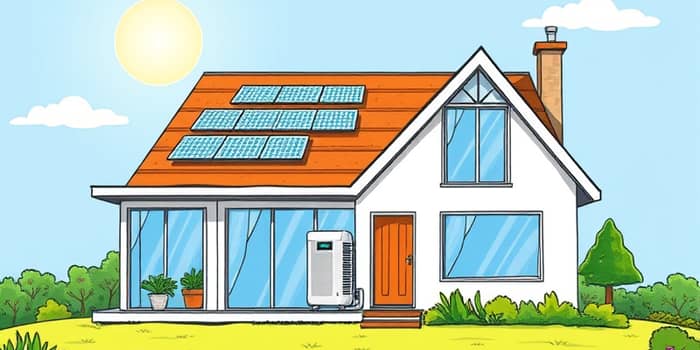
In an era of rising energy costs and mounting environmental concerns, homeowners hold a unique key to lowering utility bills and shrinking their carbon footprint. Through a blend of federal tax credits and state-managed rebate programs, families across the country can transform their living spaces into efficient sanctuaries, cutting costs and curbing emissions.
Empowering Your Home with Federal Tax Credits
Between January 1, 2023, and December 31, 2025, the Inflation Reduction Act offers homeowners a suite of incentives that reward investment in clean, efficient upgrades. The centerpiece is the Energy Efficient Home Improvement Credit (25C), which covers 30% of upgrade costs, with a generous annual limit of $3,200. These federal credits can be combined to amplify savings, ensuring every dollar spent on efficiency pays dividends in comfort and cost reductions.
- Energy Efficient Home Improvement Credit (25C)
- Residential Clean Energy Credit (25D)
- Energy Efficient New Homes Credit (45L)
The 25C credit is divided into two caps: $1,200 for items like insulation, doors, and windows; and $2,000 for high-efficiency heat pumps, heat pump water heaters, and biomass stoves that meet the Consortium for Energy Efficiency’s highest tier standards. Applications extend to both primary and secondary residences, and even renters who undertake approved improvements.
Beyond efficiency upgrades, the Residential Clean Energy Credit (25D) offers 30% of qualifying costs for solar panels, wind turbines, geothermal heat pumps, and battery storage. Homeowners can apply this credit to existing and new primary residences.
For new construction, builders and developers may utilize the Energy Efficient New Homes Credit (45L), unlocking up to $5,000 per dwelling for homes certified under ENERGY STAR or Zero Energy Ready standards. This credit encourages the creation of high-performance housing from the ground up.
Unlocking State-Managed Home Energy Rebates
Federal funding flows through state channels via Home Efficiency Rebates (HER) and Home Electrification and Appliance Rebates. Each state program features unique income thresholds, project requirements, and application processes. Many programs require a pre-upgrade audit, installation by approved contractors, and proof of energy savings.
- Whole-home retrofits combining heat pumps, insulation, and air sealing
- Targeted envelope upgrades like windows and weatherization
- Appliance swaps and electric HVAC installations
Eligibility is often income-based, typically capped at 80% or 150% of Area Median Income (AMI). Households below 80% AMI may receive up to 80% of project costs (max $8,000 for 35% savings), while those above 80% AMI may qualify for 50% of costs (max $4,000 for 35% savings). Electrification rebates can cover 100% of costs up to technology-specific limits for lower-income populations.
Real Savings and Environmental Impact
When combined, federal credits up to $3,200 per year and state rebates exceeding $8,000 for deep retrofits can slash project costs dramatically. Homeowners who invest in comprehensive upgrades see average energy reductions of 20–35%, translating to hundreds of dollars in annual bill savings. Electrification of heating and water systems further reduces greenhouse gas emissions, aligning household practices with broader climate goals.
Beyond cost savings, these upgrades enhance indoor comfort, improve air quality, and elevate property values. By replacing fossil fuel systems with electric heat pumps and fortifying the building envelope, families create healthier, safer, and more resilient homes.
Taking Action: Steps to Maximize Incentives
- Schedule a professional home energy audit to identify priority upgrades.
- Verify your income eligibility against state AMI thresholds.
- Choose products that meet CEE Tier 1 or ENERGY STAR specifications.
- Apply for state rebates prior to purchase or installation.
- Keep detailed receipts and certification documents for tax credit claims.
By following a clear roadmap, you can combine rebates and credits without overlap, ensuring that you maximize every incentive. Remember to subtract only utility rebates from project costs when calculating tax credit eligibility, and retain all contractor warranties and manufacturer certificates.
Looking Ahead: A Sustainable Future
As federal credits wind down in 2025, the legacy of today’s investments will shape the energy landscape for decades. State rebate programs are designed to bridge the gap, offering long-term support for families pursuing cleaner, more efficient living spaces. Every upgrade you make is a vote for a healthier planet, reduced reliance on fossil fuels, and a legacy of savings for future generations.
Embrace this moment to transform your home into an energy-efficient haven. By leveraging available incentives, you not only unlock substantial financial gains but also champion a sustainable future—one upgrade at a time.
References
- https://energyefficiencyalliance.org/federal-energy-efficiency-programs/
- https://chanceyhvacdouglas.com/georgia-hvac-incentives-for-2026-you-should-know/
- https://www.youtube.com/watch?v=tc4aYjjqNP8
- https://www.irs.gov/credits-deductions/energy-efficient-home-improvement-credit
- https://www.energy.gov/save/home-upgrades
- https://www.energystar.gov/about/federal-tax-credits
- https://programs.dsireusa.org/system/program/detail/22720/georgia-home-efficiency-rebate-her-program
- https://www.energystar.gov/rebate-finder
- https://www.energy.gov/save